SaaS product videos
Google's AI That Understands Live Video
Google StreamVibe: Can AI Understand Video in Real Time?
By Ahsan AliPublished Updated 10 min read
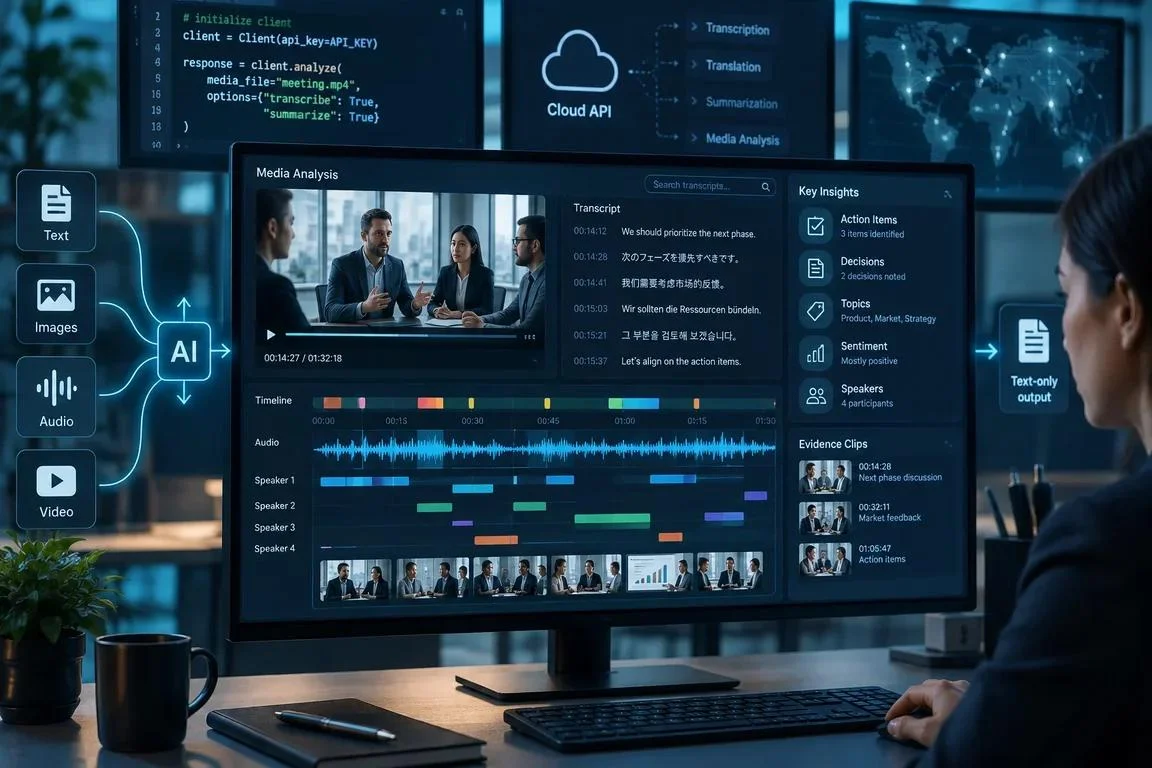
Google StreamVibe AI is an experimental system that analyzes continuous video, tracks changing user intentions, and attempts to provide assistance at the right moment without requiring a new instruction each time. It demonstrates how AI can move beyond describing what's happening on screen toward understanding when someone may need help, although reliable performance across long, complex tasks remains an open challenge. A research paper published on October 26, 2026, introduced the technology, with broader news coverage following on November 1. The research raises an important question for video creators, software companies, and production professionals: Could similar AI eventually understand an editing workflow well enough to assist with decisions as they happen?
What Is Google StreamVibe AI?
StreamVibe is a research framework for proactive, intent-aware video assistance developed by researchers affiliated with Google and several universities.
Its purpose is to help AI systems interpret ongoing visual activity, understand what a user is trying to achieve, and determine whether assistance is needed.
Consider someone following a complex tutorial.
A conventional AI assistant might wait until the user asks a question.
A proactive assistant could potentially recognize that the user has missed a step and offer guidance before the mistake creates another problem.
The distinction is significant.
Recognizing objects and actions in a video is only one part of understanding a situation. Providing useful assistance requires the system to remember what happened earlier, interpret the user's goal, and decide whether speaking would be helpful.
StreamVibe investigates how to bring these capabilities together.
The project involves researchers affiliated with Google, UC Santa Barbara, UC Santa Cruz, Stanford University, the University of Oxford, Emory University, and Columbia University.
Importantly, the published work describes a research system rather than a commercial Google video editing product.
What Did Google Researchers Announce in October 2026?
The research paper, titled StreamVibe: Proactive Video Agents for Evolving User Intent, was submitted to arXiv on October 26, 2026.
On November 1, technology publication The Decoder covered the project and highlighted its approach to understanding user intentions during continuous video interactions.
The researchers introduced three connected components:
StreamVibe-Bench: A benchmark for evaluating how AI responds to different types of user intentions.
StreamVibe-VL: A vision-language model trained to decide when and how to assist during a video stream.
StreamVibe-Harness: A memory and state-management system designed to track active requests, previous interactions, and task progress.
Together, these components tackle a problem that becomes increasingly important as AI assistants move into real-world workflows.
An assistant must understand not only what is happening but also what matters to the person using it.
How Does StreamVibe Understand Live Video?
StreamVibe uses a streaming vision-language model to analyze ongoing visual information and make decisions about whether to respond.
Rather than treating every frame as an isolated image, the system is designed to consider the user's current goal, the progress of the task, and relevant interaction history.
Its research framework focuses on three categories of user intent.
1. Explicit Intent: Responding to Clear Instructions
Explicit intent occurs when a user provides a specific instruction or condition.
For example:
"Let me know when the water starts boiling."
The AI must observe the relevant activity and respond when the requested event occurs.
This is comparatively straightforward because the user has already defined what the assistant should watch for.
2. Implicit Intent: Understanding What the User Needs
Implicit intent is more challenging.
Imagine a user says:
"Help me prepare this recipe."
The user hasn't specified every moment when assistance will be needed.
The AI has to observe the process, recognize relevant actions, and decide when guidance would be useful.
Instead of simply describing what the person is doing, it needs to connect observations to the broader task.
3. Dynamic Intent: Adapting When Instructions Change
Real users frequently change their minds.
Someone might initially ask an assistant to summarize each completed stage, then decide they only want warnings when something goes wrong.
A useful AI system should recognize that the original instruction has changed.
StreamVibe explores how models can update their understanding rather than repeatedly following outdated requests.
This ability to adapt is one of the project's most interesting research goals.
What Do StreamVibe's Research Results Actually Show?
The researchers created StreamVibe-Bench to evaluate proactive AI behavior across physical tasks and software interactions.
According to the original research, the benchmark includes:
Research metric | Reported figure |
|---|---|
Evaluation samples | 4,100 |
Annotated assistance points | 20,546 |
Video footage | 183.4 hours |
Training samples | Approximately 85,000 |
Intent subtypes | 10 |
The research team reports that StreamVibe-VL improved response timing and answer quality by 10.7% against its comparison baselines.
The separate memory-based harness also produced a reported 12.3% improvement in proactive interaction performance.
These are results from the researchers' evaluations, not independent proof that the system performs equally well in every real-world environment.
The findings are encouraging, but they come with an important qualification.
Current AI systems still struggle to maintain reliable understanding during extended video interactions.
In the study, performance deteriorated when models had to process ongoing activity and rely on their own previous responses.
That means an AI assistant may correctly interpret one moment but lose track of the larger task as the session continues.
The results demonstrate progress, not a solved problem.
Why Is Long-Form Video Understanding Still Difficult for AI?
A five-second clip and a 20-minute video present very different technical challenges.
A short clip might contain one obvious action.
A longer video may involve several people, changing objectives, repeated movements, interrupted tasks, and important events separated by minutes.
For an AI assistant, the difficulty extends beyond recognizing objects.
It needs to maintain a coherent understanding of what has already happened.
Consider a software tutorial in which a user completes several setup steps.
If the AI fails to remember that a configuration was already changed, it may repeat an unnecessary instruction.
If it incorrectly assumes a step was completed, it may provide guidance based on a false understanding of the software's current state.
These failures are particularly problematic in professional workflows.
The StreamVibe research highlights how mistakes can accumulate during continuous interaction, even when a model performs reasonably well on individual decisions.
This is one reason why analyzing video and reliably assisting throughout a complete task remain different capabilities.
What Could StreamVibe Mean for the Future of Video Editing?
StreamVibe is not an automatic video editor.
However, the ideas behind proactive video understanding could influence how future editing assistants are designed.
A professional editing workflow involves more than identifying scenes.
Editors interpret scripts, choose visual emphasis, maintain continuity, respond to feedback, and decide which moments deserve attention.
An AI system that understands both the footage and the editor's changing objectives could potentially support several of these tasks.
The following examples are possible future applications, not features demonstrated by StreamVibe.
1. More Intelligent Footage Review
Imagine uploading several hours of interviews or documentary footage.
A future video assistant could analyze the material, identify relevant discussions, and suggest segments associated with the editor's brief.
Instead of searching footage entirely through transcripts or manual playback, the editor could receive context-aware recommendations.
However, identifying a relevant statement is not the same as deciding whether it belongs in the final story.
Editorial judgment would still be essential.
2. Context-Aware Editing Assistance
Suppose an editor is preparing a SaaS product demonstration.
The editor changes the script to emphasize one particular software feature.
A future assistant with reliable state tracking could recognize the updated objective and suggest relevant UI recordings or explanatory visuals.
The important improvement would be adapting recommendations as the production brief evolves.
3. Better Continuity Checking
Long-form videos require consistency.
Visuals must match narration, graphics should reflect the correct information, and product interfaces should be presented accurately.
A sufficiently capable AI assistant might eventually flag discrepancies between a video's script and what appears on screen.
For example, it could identify a moment where the narration refers to one feature while the footage shows another.
That would be especially useful for technical explainers and software tutorials.
4. Faster Quality-Control Reviews
Video production frequently involves several review rounds.
A context-aware assistant could potentially help editors identify missing captions, inconsistent visual elements, or segments that do not match the latest client instructions.
Yet these possibilities depend on accurate temporal understanding, access to relevant project information, and reliable verification.
StreamVibe does not establish that such a production system already exists.
StreamVibe vs. Traditional AI Video Analysis
The difference between conventional video analysis and StreamVibe's research goal is the shift from responding to questions toward maintaining an ongoing understanding of a task.
Capability | Conventional video analysis | StreamVibe research approach |
|---|---|---|
Main objective | Analyze video content | Support a user during continuous activity |
User requests | Often question-driven | Explicit, implicit, or changing intentions |
Interaction | Typically reactive | Designed to be proactive |
Context | Depends on model and workflow | Persistent state tracking is a central focus |
Timing | Often responds when prompted | Researches when to respond or remain silent |
Video editing | Depends on the product | Not a commercial editing tool |
This is a comparison of common approaches and research objectives, not a claim that all existing video AI systems have identical limitations.
Google has also been developing a separate capability called agentic video understanding for Gemini.
In a September 1, 2026 announcement, Google described how supported Gemini models can selectively examine relevant video segments instead of processing every part at a fixed sampling rate.
That technology is relevant to automated video search and analysis, but it should not be confused with StreamVibe.
StreamVibe investigates proactive assistance during ongoing activity, while Gemini's announced agentic video capability focuses on more targeted analysis of video content.
Can StreamVibe Replace Professional Video Editors?
No. The published StreamVibe research does not demonstrate an AI system capable of independently producing professional, finished videos.
It addresses a different problem: understanding when a user needs help during an ongoing visual task.
Professional video editing requires several connected decisions:
Selecting meaningful footage.
Structuring a coherent story.
Matching visuals with narration.
Creating accurate and readable graphics.
Establishing pacing and emotional rhythm.
Maintaining consistent branding.
Interpreting client feedback.
Ensuring technical and factual accuracy.
An AI system may eventually assist with more of these activities, but recognition and automation are not substitutes for every creative decision.
For example, a model might identify the exact point where a speaker mentions a product benefit.
It still needs editorial direction to determine whether that moment belongs in a promotional advertisement, product demonstration, or longer documentary.
The most useful role for AI is therefore not necessarily removing the editor.
It may be helping editors spend less time locating information and more time making high-value creative decisions.
What Should SaaS Brands and Video Production Agencies Learn From This Research?
For businesses investing in video content, StreamVibe points toward the growing importance of intelligent production workflows.
But companies should distinguish between a promising research direction and technology that's ready for deployment.
Here are three practical priorities.
1. Organize Video Assets Around Their Meaning
Screen recordings, interview clips, and product demonstrations become easier to manage when they're properly labeled.
Clear filenames, transcripts, timecodes, and descriptions of visual content create a stronger foundation for both manual editing and AI-assisted retrieval.
2. Preserve Human Review of Important Claims
This is especially important for SaaS product videos.
An inaccurate animation or outdated interface can misrepresent what customers will actually experience.
Every significant product claim should be checked against the real software before publication.
3. Evaluate AI Tools Against Actual Production Problems
Before adopting an AI system, define what it should improve.
Is the goal faster footage search, more accurate captions, better first-cut preparation, or improved review workflows?
Measure performance on real project material rather than relying only on demonstrations.
For agencies, a practical AI workflow should improve quality, consistency, or efficiency without introducing additional inaccuracies.
What Are StreamVibe's Current Limitations?
The research is notable precisely because it addresses problems that existing systems haven't reliably solved.
Several limitations deserve attention.
Long-session reliability: Performance can deteriorate as models accumulate their own interaction history.
Changing intent: Recognizing that a user has revised an instruction remains challenging.
Response timing: The assistant may provide useful information too early, too late, or when no assistance is needed.
Real-world complexity: Controlled research benchmarks cannot capture every unpredictable situation.
Commercial availability: StreamVibe was presented as a research project, not a general-purpose commercial product or editing application.
For professional workflows, additional questions would also need to be addressed, including sensitive footage handling, system latency, permission controls, and integration with existing editing software.
These are practical deployment considerations rather than capabilities or limitations fully measured in the StreamVibe paper.
The Future of AI-Assisted Video Production
Video AI is moving beyond simple scene descriptions.
Research projects such as StreamVibe explore systems that can follow ongoing activities, interpret changing objectives, and make more contextually relevant decisions.
That direction could eventually support smarter production assistants.
But the research also demonstrates how difficult reliable long-form understanding remains.
For professional video production, the next meaningful advance may not be another tool that automatically generates more effects.
It may be an assistant that understands the project's requirements, remembers feedback, identifies genuine mistakes, and knows when to leave a creative decision to the editor.
The future is likely to involve a changing balance between automation and human oversight, with the exact role of each determined by task complexity and system reliability.
Turn Your Ideas Into Professional Video Content With NexaCuts
At NexaCuts, we focus on SaaS product videos, video sales letters, promotional videos, and professional video editing.
Whether you're launching software, explaining a complex product, or preparing marketing content, our production approach centers on clear visual communication and intentional storytelling.
Explore NexaCuts' video production services to discuss how your next project can communicate its message more effectively.
Sources and Further Reading
Original research paper: StreamVibe: Proactive Video Agents for Evolving User Intent — arXiv — October 26, 2026.
Official project website: StreamVibe Research Project — Methodology, demonstrations, and benchmark information.
News coverage: The Decoder — Google Wants Video AI to Understand What People Need as They Work — November 1, 2026.
Related Google technology: Introducing Agentic Video Understanding With Gemini — September 1, 2026.
Research and news last checked: November 2, 2026.
FAQ
What is Google StreamVibe AI?
StreamVibe is a research framework for proactive video assistance. It combines a streaming vision-language model, a benchmark, and a memory system to study how AI can understand user intentions during continuous video interactions.
Can StreamVibe understand live video in real time?
StreamVibe is designed to process ongoing video and decide when assistance is appropriate. Its research results show progress, but reliable understanding across long and changing tasks remains difficult.
Is StreamVibe available for public use?
As of November 2, 2026, the official project page presents StreamVibe as a research project and labels its code and Hugging Face releases as forthcoming. Public availability may change.
Is StreamVibe an AI video editing tool?
No. StreamVibe focuses on proactive interaction and understanding user intentions during visual tasks. It is not presented as software for editing, rendering, or exporting finished videos.
Will AI replace human video editors?
AI may automate additional production tasks, but professional editing also requires storytelling, design judgment, factual verification, and interpretation of business objectives. StreamVibe does not demonstrate that these responsibilities can be fully automated.
Why is StreamVibe important for video production?
The research explores how AI could move from analyzing isolated video content toward maintaining an understanding of ongoing tasks. Similar advances might eventually support more context-aware footage review, editing assistance, and quality control.
Final Thoughts: AI Video Understanding Is Improving, but Context Still Matters
StreamVibe highlights an important direction in artificial intelligence. The goal is no longer only to identify what's happening in a video. Researchers are also exploring whether AI can understand what a person is trying to accomplish and respond at the right moment. That's a meaningful challenge, and the published results show both progress and substantial remaining limitations. For video creators, SaaS companies, and marketing teams, the practical lesson is to evaluate AI through the quality of the work it helps produce. Technology can support production, but clarity, accuracy, creative decisions, and audience understanding remain central to effective video content.

Written by Ahsan Ali
Ahsan Ali is the Founder & Creative Director of NexaCuts, specializing in SaaS video production, VSL editing, and promotional videos for businesses and brands.