Blog
NVIDIA CEO Jensen Huang Resigns After 33 Years: What Happens Next for AI?
NVIDIA confirms Jensen Huang's resignation, appoints Colette Kress as interim CEO, and begins a new chapter for the world's leading AI chipmaker. Here's what happened and what it means for AI, technology, and video creators.
By Ahsan AliPublished Updated 11 min read
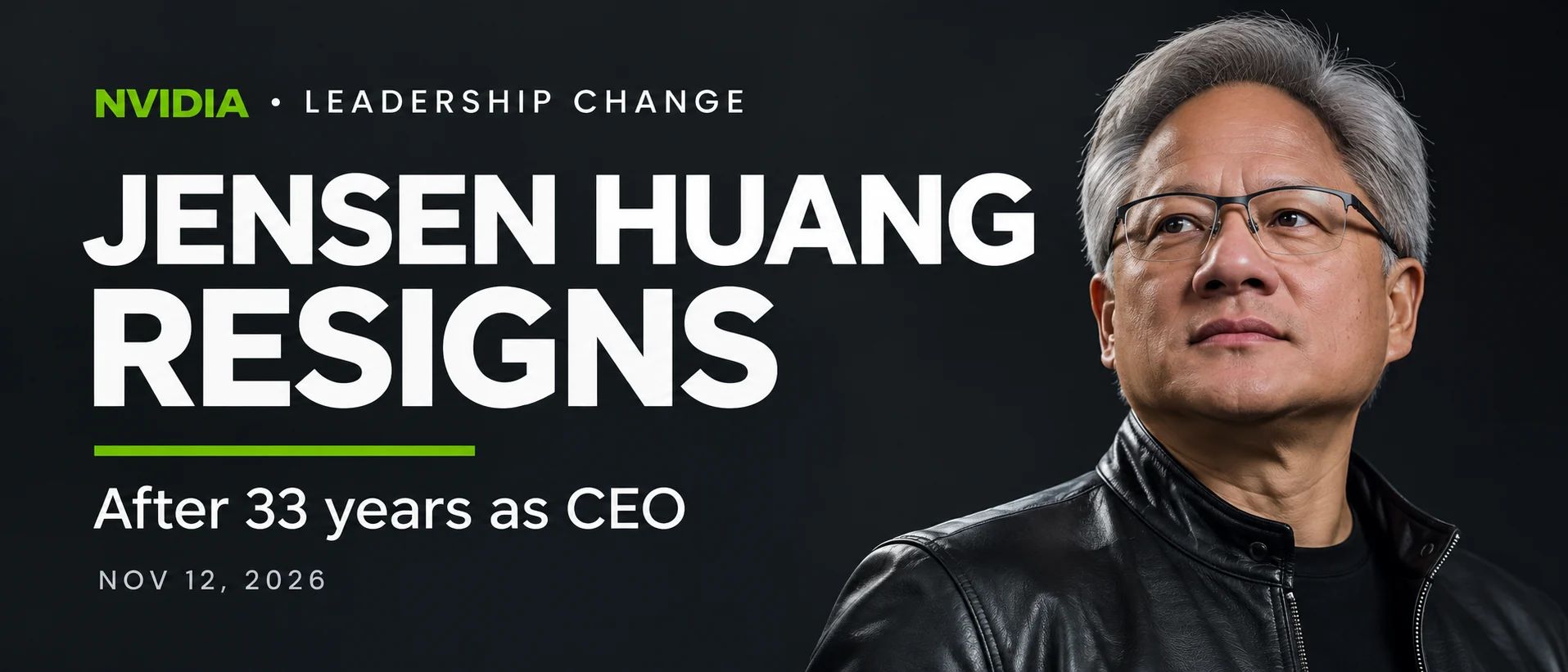
NVIDIA CEO Jensen Huang resigned on November 12, 2026, stepping down immediately as chief executive, president, and board member after leading the company since its founding in 1993. NVIDIA appointed Chief Financial Officer Colette Kress as interim CEO and named Harvey C. Jones board chair while beginning its search for a permanent successor. The unexpected leadership change follows days of controversy and an independent board investigation into reported national security concerns. But Huang's departure raises a much larger question: What happens when the person who helped build the modern AI infrastructure industry suddenly leaves one of its most influential companies? For technology businesses, AI developers, and video production professionals, understanding the consequences requires looking beyond the headlines.
NVIDIA CEO Jensen Huang Resigns: What Happened on November 12, 2026?
NVIDIA officially announced the departure of its co-founder and longtime CEO Jensen Huang on Thursday, November 12, 2026.
The company confirmed that Huang resigned from three positions, effective immediately:
Chief Executive Officer
President
Member of the Board of Directors
NVIDIA simultaneously announced a leadership transition designed to maintain operations while the board selects a permanent successor.
Colette Kress, the company's executive vice president and chief financial officer, has taken over as interim CEO.
Harvey C. Jones, a longtime NVIDIA director and former Synopsys executive, has been appointed chair of the board.
The announcement marks the end of one of the most consequential founder-led CEO tenures in modern technology.
Huang co-founded NVIDIA in 1993 and led its transformation from a graphics chipmaker into a central supplier of the computing infrastructure powering artificial intelligence.
His resignation comes at a particularly sensitive time for the company, with intense competition in AI infrastructure and increasing attention on U.S. semiconductor export policy.
Official announcement: NVIDIA Announces CEO Transition — November 12, 2026.
Why Did Jensen Huang Resign From NVIDIA?
The circumstances surrounding Jensen Huang's resignation have attracted international attention.
However, it is essential to distinguish the confirmed corporate announcement from allegations reported by news organizations.
NVIDIA's November 12 CEO transition statement confirmed his resignation but did not explicitly identify a single cause.
In the days preceding the announcement, multiple publications reported concerns involving Huang's personal relationships and possible foreign intelligence targeting.
On November 8, Huang issued a public message acknowledging that he had been unfaithful to his wife and apologizing to his family and NVIDIA colleagues.
NVIDIA's board also announced an independent investigation into reports that Huang may have been targeted by a foreign intelligence effort.
In its statement, the board said it had no reason to believe NVIDIA secrets or national security had been compromised.
By November 11, Reuters and other major publications were reporting that the board was considering Huang's future.
His resignation followed on November 12.
Were the Espionage Allegations Proven?
No public finding establishing that Huang knowingly participated in espionage was provided in NVIDIA's resignation announcement.
Reports concerning a Chinese businesswoman and suspected foreign intelligence activity remain distinct from confirmed findings about wrongdoing.
The Associated Press noted that it could not independently verify certain additional allegations involving Huang's relationships.
NVIDIA's independent investigation was announced before the resignation, but the CEO transition statement did not provide its final findings.
The responsible conclusion is that the controversy and investigation preceded Huang's departure, while the full circumstances and any legal implications remain subject to further reporting.
Sources: NVIDIA's November 8 board statement, Jensen Huang's public message, and Reuters' resignation coverage.
Timeline: How NVIDIA's Leadership Crisis Developed
The events leading to the announcement unfolded over several days.
Date | Confirmed development |
|---|---|
November 8, 2026 | NVIDIA's board announces an independent investigation into reported foreign intelligence concerns |
November 8, 2026 | Jensen Huang publicly acknowledges personal misconduct and apologizes |
November 10, 2026 | Independent board members announce outside legal counsel for the investigation |
November 11, 2026 | Media report that NVIDIA's board is reviewing Huang's future |
November 12, 2026 | NVIDIA confirms Huang's immediate resignation and appoints interim leadership |
November 17, 2026 | NVIDIA's next quarterly earnings announcement is scheduled |
This timeline shows how quickly a corporate governance issue became a major leadership transition.
It also explains why investors, customers, and technology partners are watching NVIDIA's next steps closely.
Who Is Colette Kress, NVIDIA's New Interim CEO?
Colette Kress is NVIDIA's interim chief executive officer following Jensen Huang's resignation on November 12, 2026.
Kress has served as NVIDIA's chief financial officer since September 2013.
Before joining NVIDIA, she spent nearly 25 years working in finance roles at major technology companies, including Microsoft and Cisco.
During her time at NVIDIA, she helped oversee the financial operations of a company experiencing extraordinary growth in accelerated computing and AI infrastructure.
Her experience with NVIDIA's financial position, customers, business operations, and executive team provides an established foundation for the transition.
However, Kress's appointment is temporary.
NVIDIA has confirmed that its board will consider both internal and external candidates for the permanent CEO position.
Kress will continue serving as CFO while also fulfilling the responsibilities of interim CEO.
Who Is Harvey C. Jones?
Harvey C. Jones has been appointed NVIDIA's first-ever chair of the board.
He has more than three decades of experience as an entrepreneur, technology executive, and venture investor.
His previous leadership positions include serving as CEO and executive chairman of Synopsys.
The appointment creates a clearer separation between board leadership and executive management following Huang's departure.
For investors, the immediate questions are whether the new structure can maintain strategic continuity and how quickly the board will identify a permanent CEO.
Why Jensen Huang's Resignation Matters for the AI Industry
To understand the significance of the announcement, it helps to understand NVIDIA's role in modern computing.
NVIDIA is not simply a manufacturer of gaming graphics cards.
Its GPUs, accelerated computing platforms, networking technologies, and software ecosystem are foundational to a wide range of AI applications.
These include:
Training large artificial intelligence models.
Running generative AI inference.
Processing data in cloud infrastructure.
Supporting scientific computing.
Accelerating professional graphics and rendering.
Powering AI-assisted creative applications.
Over more than three decades, Huang helped position the company at the center of several major technology transitions.
The company's growth was closely associated with his strategic decisions and public leadership.
That creates what investors often call key-person risk: the possibility that an organization depends heavily on one individual for strategy, relationships, or execution.
A leadership change doesn't automatically damage the underlying technology.
But it introduces uncertainty about how future decisions will be made.
How Did NVIDIA Stock React to Jensen Huang's Resignation?
NVIDIA shares fell sharply following reports of the leadership crisis and the official resignation announcement.
Reuters reported that the stock declined by more than 14% at one point during early trading on November 12 before recovering part of its losses.
The broader technology market also came under pressure as investors assessed the implications.
However, an intraday price movement should not be confused with a final closing price.
The immediate reaction reflects uncertainty rather than proof that NVIDIA's products, revenue, or technical capabilities have deteriorated.
Investors are likely to focus on several questions:
Can the new leadership team maintain NVIDIA's existing execution?
Will the company continue its announced technology roadmap?
How will a permanent CEO be selected?
Could regulatory scrutiny affect international operations?
Will major customers maintain confidence in NVIDIA's long-term strategy?
These questions are important because NVIDIA operates within a complex global technology ecosystem.
The market's longer-term assessment will depend on future results, leadership decisions, and execution—not one day's headlines.
Will NVIDIA's AI Technology Roadmap Change?
NVIDIA has not announced a cancellation or replacement of its existing AI product roadmap as a result of Huang's resignation.
In the November 12 announcement, the company's new leadership expressed its intention to maintain operations and existing commitments.
Board Chair Harvey Jones said NVIDIA expects customer commitments and the technology roadmap to continue without interruption.
That statement provides reassurance about the company's immediate plans.
However, it is a statement of management's expectations, not a guarantee that every future project will remain unchanged.
A new permanent CEO may eventually make strategic decisions that differ from those of Huang.
For now, businesses should distinguish between the uncertainty surrounding leadership and any actual changes to NVIDIA's technology products.
What Does Jensen Huang's Resignation Mean for Video Editors?
NVIDIA's leadership transition is also relevant to professionals working in video editing, motion graphics, animation, and AI-generated media.
NVIDIA technology is widely used throughout modern creative production.
Its hardware and software ecosystem supports tasks ranging from video playback and rendering to AI-assisted processing.
However, the CEO's resignation does not mean existing NVIDIA GPUs or creative software have stopped working.
As of the announcement, NVIDIA has not disclosed any immediate change to NVIDIA Studio, GPU driver support, or professional video processing functionality caused by the leadership transition.
1. NVIDIA GPU Acceleration in Video Editing
Many editing workflows use GPUs to accelerate demanding tasks.
Depending on the application and hardware, GPU acceleration can support:
Video playback and decoding.
Color grading and visual effects.
AI-powered masking and enhancement.
Motion graphics and 3D rendering.
Hardware-accelerated video exports.
NVIDIA's video processing ecosystem includes technologies such as CUDA, NVENC, and NVDEC.
NVENC handles supported hardware video encoding tasks, while NVDEC accelerates video decoding.
These technologies are important because editors regularly work with large footage files, demanding effects, and multiple export formats.
The current leadership change does not establish that these features will be discontinued.
2. NVIDIA Studio and Professional Creators
NVIDIA Studio is the company's platform focused on professional and creative workflows.
It includes hardware acceleration, driver support, and tools designed for video editing, 3D design, broadcasting, and other creative tasks.
NVIDIA's own Studio documentation highlights accelerated editing, rendering, AI effects, and export workflows.
For video production agencies, these capabilities can help manage technically demanding projects.
The practical concern following Huang's resignation is therefore not whether current editing software has suddenly become unusable.
It is whether NVIDIA will maintain its investment in the creative ecosystem over the longer term.
There is no confirmed immediate withdrawal from that market.
Technical reference: NVIDIA Studio — Official Creator Platform.
3. AI Video Generation and Processing
AI-generated video is becoming an important area of creative technology.
Some generative video systems run on large GPU clusters, while other tools perform selected inference and enhancement tasks on local hardware.
NVIDIA technology supports many of the computational processes used throughout this ecosystem.
For example, GPUs can accelerate operations associated with model inference, upscaling, video analysis, and certain generative workflows.
But not every AI video platform uses NVIDIA hardware in exactly the same way.
Cloud providers may operate different infrastructure, and application developers can choose between multiple computing platforms.
The significance of NVIDIA's leadership change will depend on how the company maintains its hardware and software development strategy—not on an assumption that AI video generation must immediately change.
Should Video Production Agencies Be Worried?
At this stage, there is no evidence that Jensen Huang's resignation requires video production agencies to change their existing NVIDIA-based workflows.
The more useful response is to maintain normal technical and business risk management.
Keep Production Systems Stable
Editors should continue using stable drivers and software versions suited to their production environment.
There is no technical reason to perform emergency hardware changes solely because NVIDIA has a new interim CEO.
Maintain Project Backups
Professional teams should keep reliable project backups, media archives, and documented export settings.
These are sensible practices regardless of which technology company supplies the hardware.
Evaluate AI Tools Individually
An AI tool should be judged by its output quality, reliability, cost, and usefulness.
Its relationship to a particular GPU company does not automatically determine whether it is suitable for a project.
Keep Creative Quality the Priority
For agencies producing SaaS product demos, promotional videos, or video sales letters, technical processing power supports production.
But the final result still depends on clear messaging, accurate product visuals, purposeful editing, and quality control.
A faster render doesn't automatically produce a better advertisement.
What Could Happen Next at NVIDIA?
There are several possible directions for NVIDIA following the transition.
These are scenarios rather than confirmed company plans.
Scenario 1: Business Continuity Under New Leadership
NVIDIA's existing executive team could continue executing its established product strategy while the board appoints a permanent CEO.
This would be the most straightforward short-term outcome.
It would allow the company to focus on customer commitments, hardware releases, and ongoing AI infrastructure development.
Scenario 2: A New CEO Reshapes Strategic Priorities
A permanent successor may eventually introduce different operational or investment priorities.
Potential areas of focus could include cloud partnerships, AI infrastructure, international business development, and software platforms.
Such changes would require actual decisions and announcements.
They should not be treated as inevitable consequences of Huang's resignation.
Scenario 3: Increased Governance and Regulatory Scrutiny
The resignation follows an independent investigation and wider questions about corporate governance and national security.
NVIDIA may face continued attention from regulators, lawmakers, and shareholders.
The long-term consequences depend on future findings and developments.
At present, the outcome of the investigation and any additional regulatory actions should not be presumed.
What Should SaaS Companies and AI Businesses Take Away?
For technology businesses, NVIDIA's leadership change illustrates an important principle.
Even a highly successful company can face risks unrelated to the quality of its products.
Leadership, governance, supplier concentration, and organizational resilience all matter.
This has practical implications for SaaS companies developing AI-powered products.
Avoid Depending Entirely on One Supplier
If an application relies on one infrastructure provider, model, or external API, disruption can create operational challenges.
Where practical, companies should understand their dependencies and maintain contingency plans.
Separate Product Reliability From Corporate Headlines
A change in executive leadership does not necessarily mean an immediate deterioration in the company's technology.
Businesses should monitor official product announcements, support documentation, and operational performance.
Communicate Technology Clearly
As AI services become more complex, businesses need to explain what their products actually do.
A clear SaaS product demonstration can show customers the real workflow instead of relying on vague promises about artificial intelligence.
For this reason, accurate product communication remains important regardless of who leads an infrastructure company.
Final Thoughts: NVIDIA Enters a New Chapter After 33 Years
Jensen Huang's departure is one of the most consequential leadership changes in NVIDIA's history.
He helped build the company from a graphics technology startup into a central force in AI computing.
His resignation comes during a period of intense interest in generative AI, semiconductor infrastructure, and advanced computing.
NVIDIA now faces the task of demonstrating that its technology leadership, customer relationships, and long-term strategy can continue without its founding CEO.
For developers, creators, and video production professionals, the immediate lesson is not to panic.
The company's hardware and software ecosystem remains in operation, and its new leadership has stated its intention to maintain continuity.
The real measure of this transition will be what NVIDIA does next.
Professional Video Production in the AI Era
At NexaCuts, we create SaaS product videos, video sales letters, promotional content, and professionally edited business videos.
As AI tools change the creative landscape, effective video production still requires clear storytelling, accurate visuals, thoughtful motion graphics, and consistent quality.
Whether you're launching an AI-powered SaaS product or explaining complex technology to customers, our focus is turning complicated ideas into understandable, engaging video content.
Explore NexaCuts' SaaS video production and editing services to discuss your next project.
Sources and Further Reading
NVIDIA — NVIDIA Announces CEO Transition. November 12, 2026.
Reuters — NVIDIA CEO Jensen Huang Resigns. November 12, 2026.
Associated Press — NVIDIA CEO Resignation and Security Concerns. November 12, 2026.
NVIDIA — Statement From the Board of Directors. November 8, 2026.
NVIDIA — A Message to Our Company. November 8, 2026.
NVIDIA — Statement From Independent Board Members. November 10, 2026.
News last verified: November 12, 2026. This article covers an evolving situation and should be updated if new leadership decisions or investigative findings are announced.
FAQ
Did NVIDIA CEO Jensen Huang resign?
Yes. NVIDIA officially announced Jensen Huang's resignation on November 12, 2026. He stepped down immediately as CEO, president, and board member after leading the company since 1993.
Why did Jensen Huang resign?
His departure followed reports concerning personal relationships, an independent investigation, and questions about potential national security risks. NVIDIA's official transition announcement confirmed the resignation but did not specify a single definitive reason.
Who is the new CEO of NVIDIA?
Colette Kress is NVIDIA's interim CEO. She previously served as the company's chief financial officer and will continue handling CFO responsibilities until a permanent successor is appointed.
Has NVIDIA appointed a permanent CEO?
Not as of November 12, 2026. NVIDIA's board announced that it will consider internal and external candidates.
Was Jensen Huang removed from NVIDIA's board?
Yes. NVIDIA confirmed that Huang resigned from the board of directors as well as his executive positions.
Will NVIDIA GPUs or video editing software be affected?
No immediate changes to GPU functionality, NVIDIA Studio, or video editing support were announced as part of the CEO transition. Long-term strategy remains a separate question.
Will NVIDIA stop developing AI chips?
NVIDIA has not announced that it will stop developing AI chips. Its interim leadership has expressed an intention to continue executing the company's established technology strategy.
When is NVIDIA's next earnings report?
NVIDIA has scheduled its third-quarter fiscal 2027 results for November 17, 2026, followed by an earnings call later that day.

Written by Ahsan Ali
Founder & lead editor, NexaCuts. Edits and produces SaaS product videos, VSLs and promotional films for brands worldwide.