Promotional videos
Video Production Becomes the Most Requested Agency Service in 2026
StudioSpace's latest report reveals growing interest in video production, animation, and motion graphics. Here's what the findings mean for businesses, SaaS brands, and marketers.
By Ahsan AliPublished Updated 9 min read
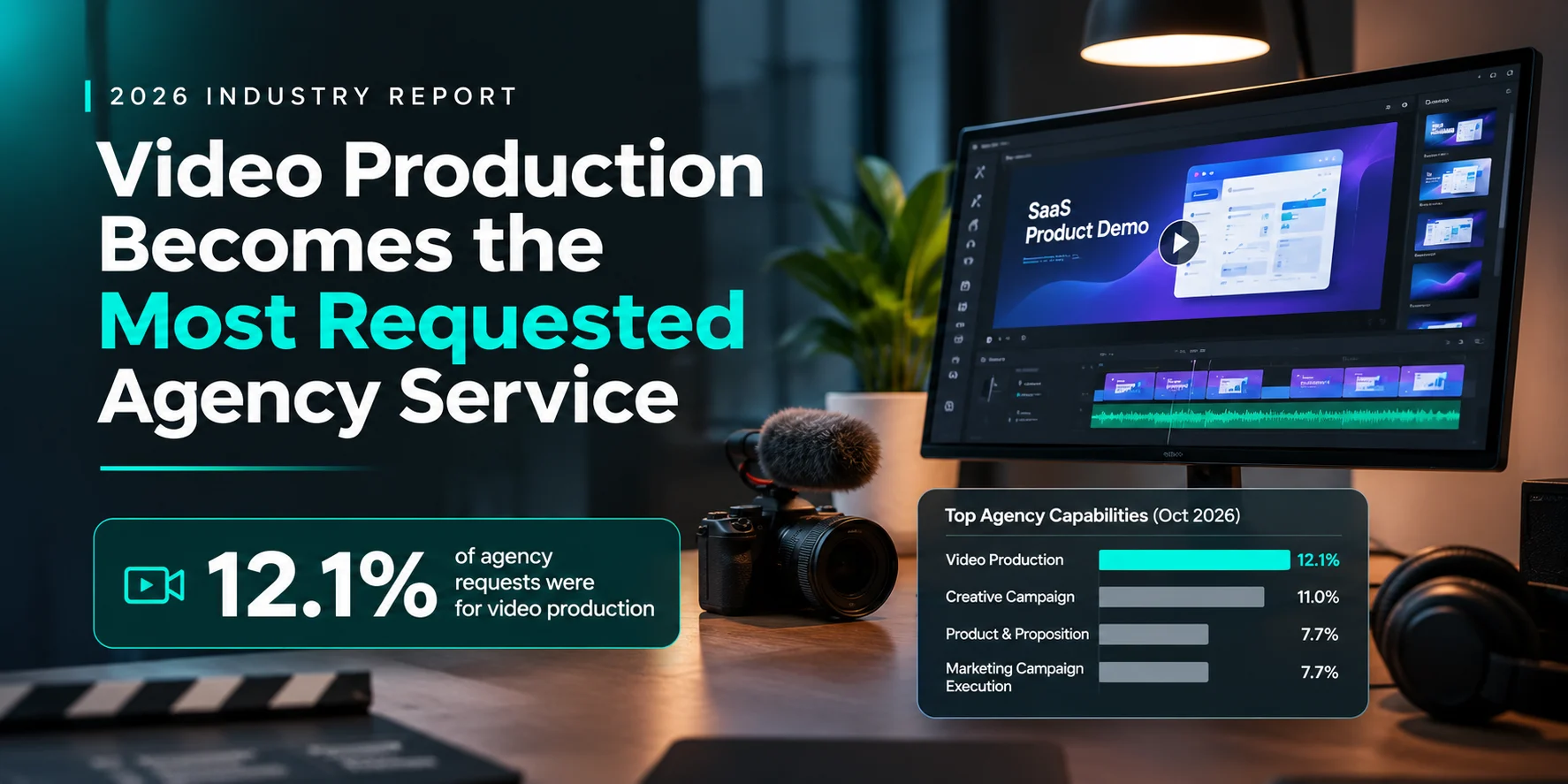
Video production became the most requested agency capability on the StudioSpace platform in October 2026, accounting for 12.1% of all capabilities requested. The findings, published on November 4, reveal particularly strong interest in animation and motion graphics, although the figures represent one agency marketplace rather than the global industry. For SaaS founders, marketing teams, and business owners, the report highlights an important question: what kinds of videos are companies investing in, and how can businesses make better production decisions?
Video Production Takes the Top Spot in StudioSpace's 2026 Report
Video production moved into first place in StudioSpace's November 2026 Marketers Most Wanted report, overtaking creative campaign services.
The report analyzed agency capabilities requested through StudioSpace during October 2026.
Video Production increased its share from 10.7% in September to 12.1% in October, while Creative Campaign fell from 14.3% to 11.0%.
Here are some of the report's key figures:
Agency capability | September 2026 | October 2026 |
|---|---|---|
Video Production | 10.7% | 12.1% |
Creative Campaign | 14.3% | 11.0% |
Product & Proposition | 5.4% | 7.7% |
Marketing Campaign Execution | 5.4% | 7.7% |
Source: StudioSpace, Marketers Most Wanted: November 2026.
The numbers indicate that production-related work was receiving significant attention within the marketplace.
However, they don't necessarily indicate an industry-wide surge in video spending.
StudioSpace explains that the number of new video briefs remained relatively stable. Video Production reached first place partly because demand for early-stage creative concepts declined.
That distinction matters.
The findings are better understood as evidence of a shift in the types of projects being commissioned on the platform, rather than proof of universal market growth.
Read the official StudioSpace report.
Why Are Businesses Investing in Video Production?
Businesses use video to communicate products, demonstrate features, explain services, and support marketing campaigns.
For software and technology companies, this is particularly useful because many products are difficult to explain through static images alone.
Imagine a SaaS platform that automates financial reporting.
A written description might explain how it connects data sources, generates reports, and organizes financial information.
A video can show those capabilities in sequence.
A viewer can see the interface, follow the workflow, and understand the result.
That doesn't automatically make every video effective.
But it explains why a well-produced video can serve a practical business purpose beyond simply generating views.
There is also broader evidence that video remains important in marketing.
According to Wyzowl's State of Video Marketing 2026 survey:
91% of surveyed businesses use video as a marketing tool.
93% of surveyed video marketers consider video important to their strategy.
92% of video marketers plan to maintain or increase their video spending in 2026.
82% of video marketers report a positive return on investment from video.
The report is based on 266 respondents surveyed in late 2025, including marketing professionals and consumers.
These results reflect reported experiences and intentions, rather than guaranteed financial returns.
Explore Wyzowl's 2026 video marketing statistics.
Animation and Motion Graphics Stand Out in the Latest Report
One of the most interesting findings isn't simply that Video Production ranked first.
It's the type of video production that businesses were requesting.
According to StudioSpace's accompanying analysis, approximately three-quarters of its October video briefs involved animation or motion graphics.
The brands behind those video briefs were all in financial services.
This is a narrow sample, but it points toward a practical use case.
Financial products can involve complex processes, calculations, workflows, and information that are difficult to visualize through conventional footage.
Animation allows businesses to simplify those ideas.
For example, a financial technology company could use motion graphics to illustrate how data moves between a bank account, payment processor, and accounting dashboard.
A SaaS company could use animated interface highlights to show how its platform handles repetitive tasks.
The same principle applies to other industries.
Why Motion Graphics Work for SaaS Products
Motion graphics can help companies visualize processes that are otherwise invisible.
They are especially useful for:
Showing software workflows and integrations.
Simplifying technical explanations.
Highlighting important interface features.
Demonstrating data relationships.
Creating branded product announcements.
Supporting promotional videos.
However, animation should not replace real product demonstrations when viewers need to understand how the actual software works.
For many SaaS products, combining screen recordings with purposeful motion graphics offers a more accurate explanation.
This is an editorial recommendation, not a claim that StudioSpace measured the performance of that specific format.
Video Production and Editing Are Increasingly Connected
Professional video production is not limited to filming or generating visual assets.
Editing shapes how viewers experience the final message.
The StudioSpace report highlights this relationship.
Almost half of the video briefs on its platform also included editing requirements.
That suggests some clients prefer to commission animation and editing as part of the same project.
There is a practical advantage to this approach.
When different teams handle scriptwriting, animation, and editing without a shared creative direction, the final video can become inconsistent.
A coordinated workflow can help maintain:
Visual consistency: Typography, brand colors, transitions, and animation follow the same design principles.
Better pacing: Important scenes receive enough time for the viewer to understand them.
Clear messaging: Graphics and product demonstrations support the narration rather than distract from it.
Simpler feedback: The production team can address creative and technical changes together.
More consistent delivery: Website videos, promotional cutdowns, and social versions can be planned from the beginning.
For businesses commissioning video content, the key is to define who is responsible for the finished asset—not simply who creates the initial visuals.
Are Video Marketing Budgets Also Increasing in 2026?
The StudioSpace findings are supported by broader evidence from the UK marketing industry.
The Institute of Practitioners in Advertising published its Q3 2026 Bellwether Report on October 15.
The report found that the net balance of UK companies increasing their video advertising budgets reached +9.8%, a two-year high.
That was up from +8.2% in the previous quarter.
A net balance represents the difference between the proportion of respondents reporting upward budget revisions and those reporting downward revisions.
It does not mean total industry video spending increased by 9.8%.
The IPA findings suggest stronger budget intentions for video advertising among the surveyed UK companies.
Combined with StudioSpace's marketplace data, this provides evidence that video production and distribution remained important areas of marketing investment during 2026.
It does not establish that all markets or industries are increasing budgets at the same rate.
Read the official Q3 2026 IPA Bellwether announcement.
What Video Production Trends Matter Most for SaaS Companies?
SaaS companies need videos that help buyers understand products, evaluate solutions, and make decisions.
Based on the latest industry research and practical production requirements, several formats deserve consideration.
1. SaaS Product Demo Videos
A product demo focuses on showing how software works.
It might demonstrate how users create a project, automate a task, or generate a report.
The editing should guide attention toward the relevant actions without making the interface difficult to follow.
Best for: Product pages, sales presentations, trial onboarding, and feature launches.
2. SaaS Explainer Videos
An explainer introduces the problem a software product solves.
It often combines simple animation with product footage and narration.
These videos are useful when the product's value needs to be communicated before viewers are ready for a detailed demonstration.
Best for: Homepages, startup introductions, and new product launches.
3. Promotional Videos
Promotional videos focus on communicating a specific offer, benefit, or campaign message.
They may use faster pacing, strong visual hooks, product footage, and motion graphics.
Best for: Paid advertising, LinkedIn campaigns, YouTube promotions, and marketing launches.
4. Video Sales Letters
Video sales letters use structured messaging to explain a problem, introduce a solution, and encourage viewers to take the next step.
They often require careful coordination between narration, visual examples, product demonstrations, and calls to action.
Best for: Sales funnels, webinars, and conversion-focused marketing campaigns.
5. Feature Announcement Videos
SaaS products change frequently.
A short feature announcement video can introduce new capabilities without requiring customers to read extensive documentation.
Best for: Product updates, customer newsletters, release announcements, and social media.
The appropriate format depends on the intended audience and desired outcome—not simply what's popular.
Is AI Changing Professional Video Production?
AI is becoming part of more production workflows.
Wyzowl's 2026 report found that 63% of surveyed video marketers had used AI tools to help create or edit videos, compared with 51% in the previous edition.
That increase suggests growing adoption of AI-assisted production among respondents.
AI tools can help with activities such as transcription, captions, rough-cut preparation, asset generation, and audio cleanup.
However, these capabilities don't remove the need to evaluate the finished content.
For example, an AI-generated promotional clip may look attractive while presenting an inaccurate software feature.
An automatically assembled product video may include scenes that don't match the narration.
The practical question for businesses isn't whether AI was used.
It's whether the final video communicates the right message accurately and professionally.
Human review remains particularly important for product claims, brand consistency, accessibility, and customer-facing demonstrations.
How Can Businesses Create Better Videos Without Overspending?
Increasing video investment doesn't mean every project needs a large production budget.
A business can improve its production efficiency by planning around a clear objective.
Begin With One Specific Goal
Before production, decide whether the video should explain a product, attract prospects, generate demo bookings, or support customer onboarding.
This determines the appropriate length, format, and creative direction.
Use Real Product Assets
If you already have a working SaaS interface, existing screen recordings can be useful.
Rather than rebuilding every screen through animation, combine authentic UI footage with professional editing and selected motion graphics.
Keep the Message Focused
A short video shouldn't attempt to explain an entire product.
Focus on the problem, relevant capability, customer benefit, and next step.
Plan Reusable Content
A main explainer or promotional video can sometimes be adapted into shorter variations.
Planning those deliverables before editing begins helps avoid unnecessary rework.
Choose Production Partners Based on Scope
A specialist freelancer or small production team may be suitable for a clearly defined project.
More complex productions may require additional creative resources.
The right choice depends on the level of scripting, animation, editing, and project management required.
How Should Businesses Measure Video Production ROI?
A video's success should be evaluated against the goal it was created to support.
View counts can indicate reach, but they don't necessarily show business impact.
For different projects, companies might measure:
Video objective | Relevant metrics |
|---|---|
Brand awareness | Qualified reach, watch time, engagement |
SaaS product education | Video completion, feature-page engagement |
Lead generation | Qualified inquiries, demo bookings |
Sales conversion | Trial signups, purchases, attributed revenue |
Customer onboarding | Task completion, activation, support requests |
When possible, businesses should compare performance before and after publishing or test similar experiences with and without video.
A company may discover that a short product demo is more valuable for conversions than an elaborate brand video.
Another may find that a clear explainer improves initial product understanding.
The point is to measure the outcome rather than assuming that more expensive production automatically produces better results.
What Should Brands Look for in a Video Production Agency?
As businesses commission more video content, selecting the right partner becomes important.
A useful starting point is to review the agency's work in the specific format you need.
For a SaaS product video, evaluate whether the editor understands real interfaces and product workflows.
For a promotional campaign, consider storytelling, messaging, creative execution, and visual consistency.
A good production brief should clarify:
Target audience and objective.
Video format and expected duration.
Scriptwriting requirements.
Source footage and brand assets.
Motion graphics or animation needs.
Voiceover and sound design.
Review process and revision limits.
Final formats and deliverables.
The agency should be able to explain its approach and establish a scope appropriate to the project.
Final Thoughts: Video Production Is About Communication, Not Just Content
StudioSpace's November 2026 report provides a useful snapshot of changing agency demand.
Video Production reached first place on its marketplace, while animation, editing, and campaign execution played important roles in the projects being commissioned.
Other industry research suggests that video remains a significant marketing channel, but businesses still need to evaluate production decisions carefully.
For SaaS companies, startups, and growing brands, the objective shouldn't be to produce more videos simply because video is popular.
It should be to create content that communicates the product's value and supports a measurable business goal.
Need Professional Video Production for Your Business?
At NexaCuts, we specialize in SaaS product videos, video sales letters, promotional video production, and professional video editing.
Whether you're launching a new product, preparing a marketing campaign, or turning existing footage into polished content, we help businesses communicate their ideas through purposeful video production.
Explore NexaCuts' video production services or contact our team to discuss your project requirements and budget.
Sources and Further Reading
StudioSpace — Marketers Most Wanted: November 2026. Published November 4, 2026.
StudioSpace — November 2026: Behind the Numbers. Detailed analysis of October briefs.
IPA — Q3 2026 Bellwether Report Announcement. Published October 15, 2026.
Wyzowl — State of Video Marketing 2026. Annual survey of marketing professionals and consumers.
Research last verified: November 5, 2026.
FAQ
Is video production the most requested agency service in 2026?
Video Production ranked first among capabilities requested on the StudioSpace agency marketplace during October 2026, accounting for 12.1% of requests. This was a platform-specific finding, not a worldwide ranking of every agency service.
Why is motion graphics production in demand?
Motion graphics can help businesses explain complex processes, software interfaces, and technical products. StudioSpace reported that approximately three-quarters of its October video briefs included animation or motion graphics, mainly from financial-services brands.
Are companies spending more on video advertising?
Some research indicates stronger video marketing investment. The IPA's Q3 2026 Bellwether Report recorded a two-year high in upward video budget revisions among surveyed UK marketers. Results may differ across regions and industries.
What types of videos are useful for SaaS marketing?
SaaS product demos, explainer videos, promotional ads, feature announcements, and video sales letters serve different purposes. The best choice depends on what customers need to understand and what action the company wants them to take.
Can small businesses afford professional video production?
Yes. A focused video built using existing footage, a clear script, and purposeful editing may require fewer resources than a fully custom animated campaign. Pricing depends on the production scope and deliverables.

Written by Ahsan Ali
Founder & lead editor, NexaCuts. Edits and produces SaaS product videos, VSLs and promotional films for brands in the US, UK and Europe.